Why Quarterbacks Should Rethink the Traditional Bench Press and Embrace Dumbbell Variations
When you’re training as a quarterback, you’re not just trying to look strong, but you’re also trying to engineer strength, stability, and speed in your throwing motion. The traditional barbell bench press is a staple of many strength programs, but for the overhead-throwing athlete, like QBs, it’s worth asking: Is it the best pressing exercise? And how might dumbbell variants provide more transfer to the field?
What This Means for Quarterbacks
Putting that research into quarterback language:
- Maxing out a barbell bench press won’t automatically make you throw harder. As throwing velocity is governed by mechanics, core/hip power transfer, arm/shoulder speed, and inter-joint coordination… not just how much you can bench.
- Because your job as a QB is an overhead, rotational movement (not a simple horizontal push), you need exercises that let the shoulder complex and scapula operate through full ranges and in coordination with the trunk.
- The scapula’s role cannot be ignored. If your shoulder blade isn’t stable and moving properly, you’ll likely lose transfer of strength, reduce your throwing efficiency, and risk injury.
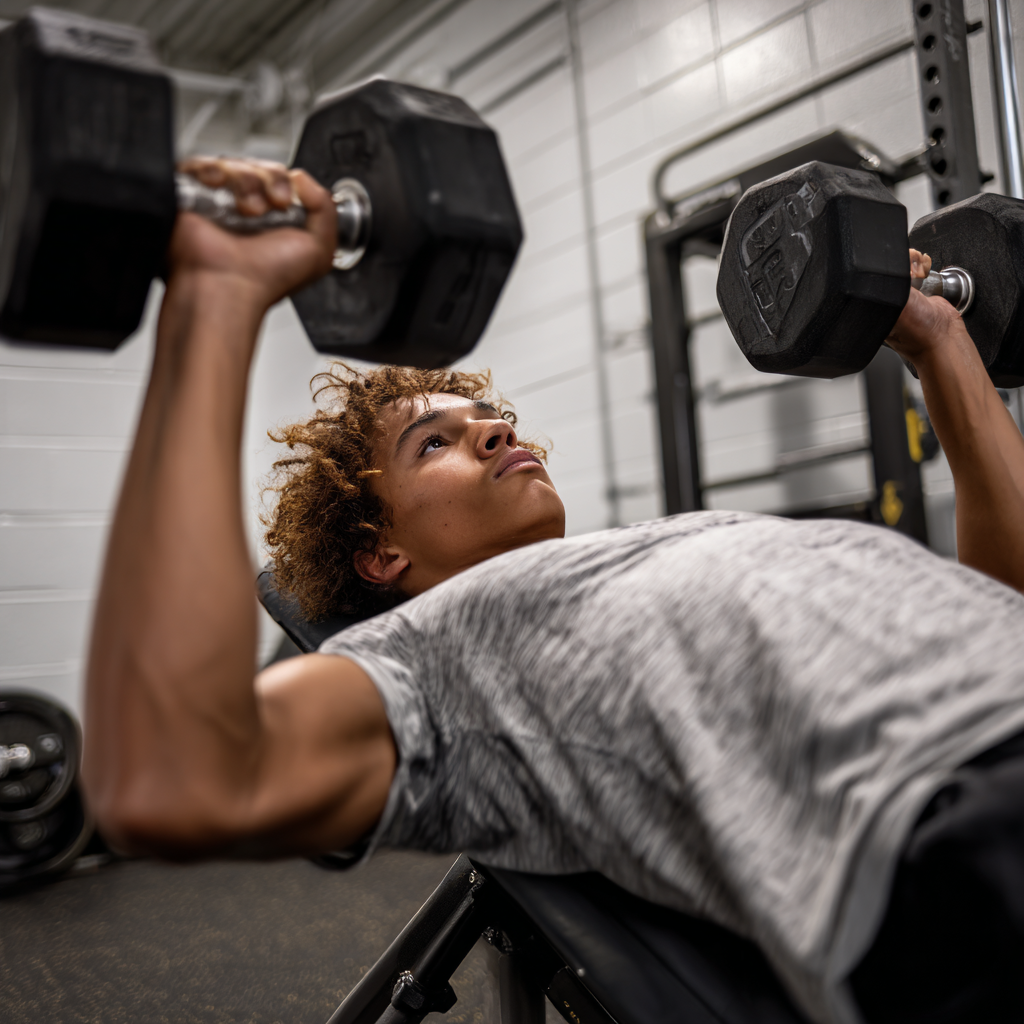
- Dumbbell variations offer more freedom of motion (especially external rotation & more scapular movement) and may thus be more appropriate for overhead/throwing athletes compared to a rigid barbell bench press.
Why We Recommend Dumbbell Pressing for QBs
Given the above, here are reasons to program dumbbell pressing over (or in addition to) traditional barbell bench pressing:
- Greater range of motion: One study showed that single-arm dumbbell bench press (versus two dumbbells) allowed statistically greater ROM in the shoulder complex.
- Independent limb work → better stability & symmetry: With dumbbells you address each arm separately which helps correct imbalances common in throwing athletes.
- Scapular and shoulder-joint safety: Because each arm moves independently, the shoulder blade can operate more naturally. Also, the pressing path is less constrained and joints can find safer alignment.
- Transfer to throwing motion: Because your throw uses single‐arm, rotational, decelerative, stabilizing movements, using dumbbell pressing that mimics more unilateral/control demands makes sense.
- Variation and explosiveness: Using incline dumbbells, single-arm dumbbells, or explosive dumbbell bench press variations can help you develop power and speed, not just brute strength.
Recommended Dumbbell Press Variations for QBs & Why
Here are some specific options, how to do them, and why they matter for the quarterback:
- Dumbbell Incline Press – Set the bench at ~30-45° incline. This works the upper chest and front deltoid in a stronger posture for the throwing shoulder (which often is elevated/abducted during throws).
- Standard Dumbbell Bench Press (flat) – Good for general horizontal strength and pushing power, but use with proper scapular setup (shoulder blades retracted/stable) so you don’t lose shoulder control.
- Single-Arm Dumbbell Press – Either flat or incline: this unilateral variation forces trunk stability, scapular control, and can highlight/ address asymmetries (dominant/throwing arm side vs non-throwing).
- Explosive Dumbbell Bench Press – Lighter loads, faster intent (for example 30-50% 1RM, or medicine‐ball throw alternatives). This builds rate of force development which is relevant for throwing.
- Incline Dumbbell with External Rotation Finish – After pressing up, rotate the dumbbell slightly outward or pause at the top and check shoulder blade position. This helps reinforce scapular upward rotation & external-rotation strength important for the throwing motion.
How to Integrate into Your QB Strength Program
Here are some general programming thoughts for athletes not naive to the weight room:
- Pre-season / off-season: Emphasize load, control, and execution. For example:
- Dumbbell incline: 4 sets of 5-8
- Single-arm DB bench: 3 sets of 6-10 each side
- Explosive DB bench (lighter, speed): 3 sets of 4-6 reps, focus “as fast as you can”
- In‐season / maintenance: Reduce volume, focus on control, stability, and avoid over-taxing the shoulder (so you’re fresh for games). Still emphasize building and maintaining power on off days.
- Warm-up and scapular prep: Before pressing, include some scapular activation (serratus anterior, lower trapezius) and external rotation work.
- Technique focus:
- Retract and depress the scapula (pull shoulder blades together/down) before pressing. This sets a more stable base.
- Controlled descent, full motion under control (don’t bounce or cheat).
- If you use explosive variants, ensure proper landing/stability after pressing. Don’t sacrifice control for speed.
- Balance your program: For every pressing exercise, you should have pulling/curling/rotator cuff/deceleration work. Because oversights in pulling/back work is a common culprit of shoulder issues in throwing athletes.
- Monitor throwing load: Because pressing adds stress to your shoulder/elbow complex, make sure you’re coordinating with your throwing volume and rest. Don’t add heavy pressing the same day you do max throw sessions or high-volume arm day.